Introduction
Africa’s drylands – arid, semi-arid, and dry sub-humid areas – are home to half the population of Africa and are vulnerable to multiple threats (Cervigni and Morris 2016). Three-quarters of Africa’s agricultural land is on drylands, but climate variability, poor infrastructure, land degradation, conflict, and political marginalization constitute major challenges to drylands. Frequent and severe droughts and related humanitarian crises divert development funding and undermine poverty reduction efforts. Moreover, drylands are expected to expand and shift due to climate change such that some zones may no longer support livestock and intensive agriculture. By 2030, the number of people vulnerable to drought is expected to increase up to 70 percent.
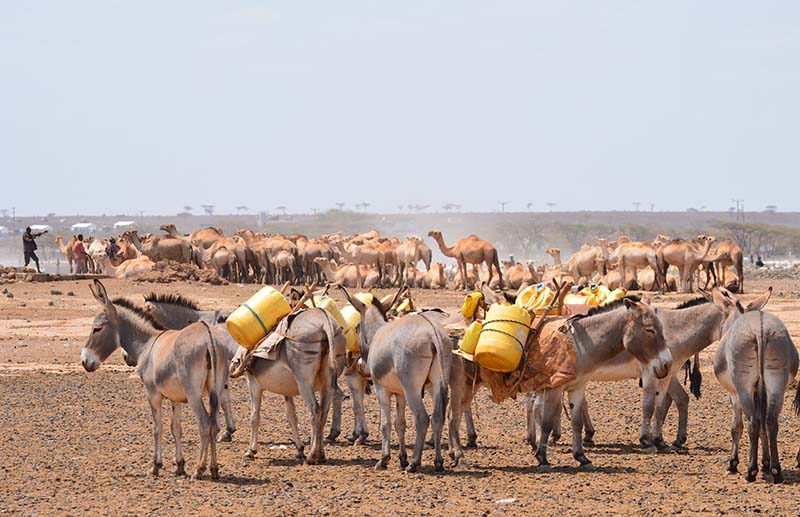
This brief focuses on the Horn of Africa, where a majority of the population has traditionally relied on pastoral and agro-pastoral systems as their main livelihood. Recent changes to pastoral and agro-pastoral systems such as changes in land tenure, increasing urban settlement, and more frequent drought are pushing people out of livestock-keeping and into alternative livelihoods. Opportunities to generate off-farm income are often classified as 1) rural non-farm agricultural activities (e.g., value chains, marketing, input supply, services), 2) rural non-agricultural activities (e.g., small businesses, vendors), and 3) urban-based activities (OECD, 2007). Evidence is mixed, though, regarding the impact of livelihood diversification on resilience, or the ability to mitigate, adapt to, and recover from shocks and stresses (USAID N.d.). Poor people tend to be more involved in agriculture and diversify into other agricultural activities, which are also climate-sensitive, so although they have diversified in terms of income streams, they have not diversified in terms of risk (e.g., drought) (Nelson et al. 2016).
The Global Alliance for Action for Drought Resilience and Growth convened a technical meeting in September 2016 to review and reflect on a series of thematic papers that were independently commissioned by DFID and USAID on livelihoods in transition in the drylands of the Horn of Africa. The meeting was the second in a series of Global Alliance-sponsored reviews of key topics to help address critical research gaps and inform programming and policy initiatives. The technical review focused on off-farm, non-agricultural livelihoods aspects, including the current scale and scope of these livelihood activities, opportunities for expansion, and the programmatic implications of both. The meeting objectives were as follows:
- Increased understanding of livelihood dynamics with a focus on off-farm, nonagricultural opportunities and how to expand these (from both the supply and demand side) as a source of diversifying livelihood risk profiles in relation to climate shocks.
- Enhanced learning among the Global Alliance members and partners to improve resilience programming in the region.
- Increased collaboration among Global Alliance members and partners
The meeting brought together a group of experts to consider livelihood dynamics in the Horn of Africa to develop recommendations for programming and policy. The meeting recognized that investments to improve current livelihoods activities (e.g., herding and farming) and funds for social protection programs are essential in enhancing the resilience of dryland populations, however, these strategies face limitations. Thus, complementary interventions are needed to support the transition to alternative livelihoods that are less sensitive to climate shocks.
The purpose of this brief is to summarize the meeting of the Global Alliance for Action for Drought Resilience and Growth and to inform programming by USAID Missions in the Horn of Africa. The following sections summarize the four recent research papers on livelihoods in the Horn of Africa that were presented at the meeting followed by programming-related recommendations to expand off-farm, nonagricultural opportunities.